General Description
VSQGs generate 100 kg (220 lb) or less of hazardous waste per month. CESQGs enjoy less burdensome RCRA record keeping and reporting requirements but must comply with the general hazardous waste management requirements. Pollution prevention techniques allow many hazardous waste generators to maintain CESQG status by minimizing waste or, in some circumstances, eliminate the hazardous waste stream entirely.
Summary of Federal Requirements
You are a VSQG if, and only if:
- you generate no more than 100 kg [220 lb] of non-acute hazardous waste in one calendar month
- total onsite accumulation does not exceed more than 1000 kg [approx. 2200 lb] of non-acute hazardous waste
- no more than 1 kg [2.2 lb] of acute hazardous waste is generated in one calendar month
- less than or equal to 100 kg [220 lb] of residues from the cleanup of any acute wastes in a calendar month.
If a facility exceeds any of the listed parameters, it must operate as a small quantity generator.
Facilities that were formerly small quantity generators have been able to scale back to being a VSQG by using the universal waste classification for its waste batteries, waste pesticides, or waste fluorescent tubes.
Hazardous waste from a VSQG must either be treated or disposed of in an onsite facility, delivered to an LQG under the control of the same person, or delivered to an offsite TSDF.
Even though a VSQG is not legally required to use a manifest or obtain a. U.S. EPA hazardous waste identification number, many hazardous waste haulers will not transport hazardous waste from a facility without a manifest or identification number.
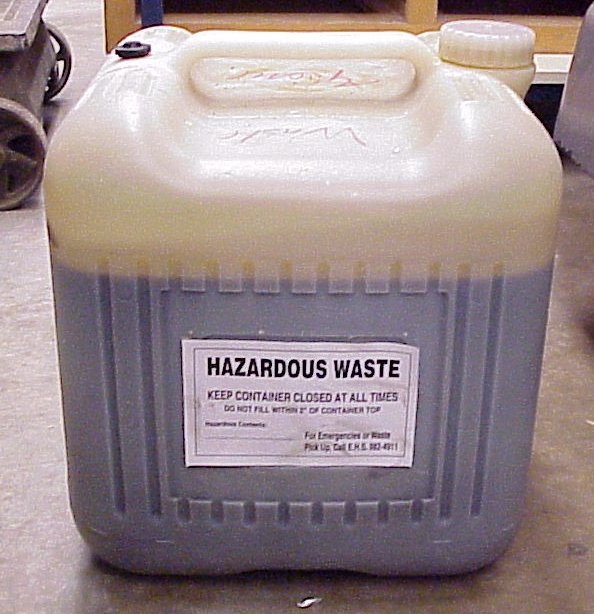
There are no specific hazardous waste storage requirements for VSQGs, it is best practice though to label containers "Hazardous Waste" and indicate a start date. NOTE: The start date is when the first waste is poured/placed into the waste container. If the VSQG is transporting the hazardous waste to an LQG under the control of the same person, the containers must be marked with the words "Hazardous Waste" and an indication of the contents hazards. The hazard can be indicated using any of the following approaches:
- the applicable hazardous waste characteristic(s) (i.e., ignitable, corrosive, reactive, toxic), or
- hazard communication consistent with the Department of Transportation requirements at 49 CFR 172 subpart E (labeling) or subpart F (placarding), or
- a hazard statement or pictogram consistent with the OSHA Hazard Communication Standard at 29 CFR 1910.1200, or
- a chemical hazard label consistent with the NFPA code 704.
Summary of State Requirements
States may require VSQGs to obtain an ID number.
States may require VSQGs to use manifests.
States may not recognize the category of VSQG, instead they may require everyone to be managed as either a small or a large quantity generator.
State-by-state guidance concerning hazardous waste can be found at ENVCAP's Hazardous Waste Resource Locator.